Einbürgerungstest : les 300 questions générales avec réponses (catalogue officiel 2025)
Les 300 questions générales du catalogue officiel du BAMF pour l’Einbürgerungstest et le test « Leben in Deutschland », mot pour mot, avec la bonne réponse et une explication. Plus les 10 questions de chaque Land et une simulation gratuite.
5 minutes · gratuit · sans compte
Entraînez-vous maintenant sur 10 questions officielles
Tirées du catalogue officiel du BAMF. Vous voyez la réponse officielle après chaque question.
Simulation complète : Einbürgerungstest
Un nouveau sujet tiré au hasard à chaque fois : 33 questions, 60 minutes, noté comme l’examen réel. Réussite à partir de 17 bonnes réponses. Gratuit, sans compte.
Votre progression
0 sur 300 travaillées · 0 justes · 0 à revoir
Quelle: BAMF, Gesamtfragenkatalog, Stand 07.05.2025 · Questions et réponses telles que publiées. Les explications sont rédigées par EUpassway et ne sont pas officielles ; le test lui-même est uniquement en allemand.
Article 5 of the Grundgesetz (Basic Law, Germany's constitution) protects freedom of opinion (Meinungsfreiheit). That is why people may openly criticise the government; freedom of religion or the right to vote are different rights.
Until the child turns 14, the parents decide whether it attends religious education (Religionsunterricht), as provided by Article 7 of the Grundgesetz (Basic Law). From 14 the child is considered religiously mature and decides for itself.
A Alle Einwohnerinnen/Einwohner und der Staat müssen sich an die Gesetze halten.✓ correct
B Der Staat muss sich nicht an die Gesetze halten.
C Nur Deutsche müssen die Gesetze befolgen.
D Die Gerichte machen die Gesetze.
Explication (EUpassway, non officielle)
In a Rechtsstaat (state under the rule of law) the laws apply to everyone: to all people in the country and to the state itself. Laws are made by parliament, not by the courts.
Freedom of opinion (Meinungsfreiheit) is a basic right under Article 5 of the Grundgesetz (Basic Law). Taking the law into your own hands (Faustrecht, Selbstjustiz) is forbidden, and owning weapons is not a basic right but strictly regulated.
A Man darf Geld annehmen, wenn man dafür eine bestimmte Kandidatin/einen bestimmten Kandidaten wählt.
B Nur Personen, die noch nie im Gefängnis waren, dürfen wählen.
C Die Wählerin/der Wähler darf bei der Wahl weder beeinflusst noch zu einer bestimmten Stimmabgabe gezwungen werden und keine Nachteile durch die Wahl haben.✓ correct
D Alle wahlberechtigten Personen müssen wählen.
Explication (EUpassway, non officielle)
A free election means nobody may pressure you, bribe you or punish you for how you vote (Article 38 of the Grundgesetz, the Basic Law). There is no compulsory voting in Germany.
Germany's constitution is called the Grundgesetz (Basic Law). It has been in force since 23 May 1949 and has applied to all of Germany since reunification in 1990.
Article 4 of the Grundgesetz (Basic Law) guarantees freedom of faith and conscience (Glaubens- und Gewissensfreiheit). An enforceable right to a job, a home or entertainment is not in the Grundgesetz.
The Grundgesetz (Basic Law) guarantees human dignity (Art. 1), equality before the law (Art. 3) and freedom of opinion (Art. 5). It does not require everyone to have the same amount of money.
The right to asylum (Article 16a of the Grundgesetz, the Basic Law) protects people persecuted for political reasons in other countries, so it only applies to foreigners. Dignity, protection of the family and free speech apply to everyone.
A fine (Geldstrafe) is a normal, permitted punishment. The death penalty is abolished (Article 102 of the Grundgesetz, the Basic Law), and torture and corporal punishment violate human dignity (Art. 1).
The constitution of the Federal Republic is called the Grundgesetz (Basic Law). This name was chosen in 1949 because it was first seen as a temporary solution until Germany was reunited.
A Ja, wenn mehr als die Hälfte der Abgeordneten im Bundestag dafür sind.
B Ja, aber dazu müssen zwei Drittel der Abgeordneten im Bundestag dafür sein.
C Nein, denn die Pressefreiheit ist ein Grundrecht. Sie kann nicht abgeschafft werden.✓ correct
D Nein, denn nur der Bundesrat kann die Pressefreiheit abschaffen.
Explication (EUpassway, non officielle)
Freedom of the press is a basic right (Article 5 of the Grundgesetz, the Basic Law). Under Article 19, the core of a basic right may not be touched, even by a majority in the Bundestag (federal parliament).
C alle Parteien, die bei der letzten Wahl die 5%-Hürde erreichen konnten.
D alle Abgeordneten, die nicht zu der Regierungspartei/den Regierungsparteien gehören.✓ correct
Explication (EUpassway, non officielle)
The opposition (Opposition) consists of all members of parliament whose parties are not part of the government. They criticise and scrutinise the government; the largest parliamentary group usually governs itself.
C Nazi-, Hamas- oder Islamischer Staat-Symbole öffentlich tragen darf.
D meine Meinung nur dann äußern darf, solange ich der Regierung nicht widerspreche.
Explication (EUpassway, non officielle)
Freedom of opinion (Article 5 of the Grundgesetz, the Basic Law) means you may freely say and write your opinion, including online and against the government. Insulting people and showing banned Nazi or terrorist symbols are criminal offences, though.
Article 12 of the Grundgesetz (Basic Law) prohibits forced labour (Zwangsarbeit), except for prisoners serving a court sentence. Free choice of occupation, by contrast, is a basic right, and military service is allowed.
A bei der öffentlichen Verbreitung falscher Behauptungen über einzelne Personen✓ correct
B bei Meinungsäußerungen über die Bundesregierung
C bei Diskussionen über Religionen
D bei Kritik am Staat
Explication (EUpassway, non officielle)
Freedom of opinion has limits, for example when you publicly spread false claims about a person (defamation, üble Nachrede/Verleumdung). Criticising the government, the state or religions is allowed.
A Meinungsfreiheit der Einwohnerinnen und Einwohner.
B Petitionen der Bürgerinnen und Bürger.
C Versammlungsfreiheit der Einwohnerinnen und Einwohner.
D Ungleichbehandlung der Bürgerinnen und Bürger durch den Staat.✓ correct
Explication (EUpassway, non officielle)
Article 3 of the Grundgesetz (Basic Law) says all people are equal before the law; the state may not discriminate against anyone because of sex, origin, religion or disability. Freedom of opinion, freedom of assembly and petitions are basic rights, not forbidden.
Article 1 begins with the sentence: Human dignity shall be inviolable (Die Würde des Menschen ist unantastbar). The right to life is in Article 2, freedom of religion in Article 4 and freedom of opinion in Article 5.
A Man darf sich seinen Wohnort selbst aussuchen.✓ correct
B Man kann seinen Beruf wechseln.
C Man darf sich für eine andere Religion entscheiden.
D Man darf sich in der Öffentlichkeit nur leicht bekleidet bewegen.
Explication (EUpassway, non officielle)
Freizügigkeit (freedom of movement, Article 11 of the Grundgesetz) means you may stay anywhere in Germany and freely choose where you live. Changing jobs or religion are covered by other basic rights.
A party that wants to abolish democracy and set up a dictatorship is unconstitutional (verfassungswidrig, Article 21 of the Grundgesetz). Only the Bundesverfassungsgericht (Federal Constitutional Court) can ban it.
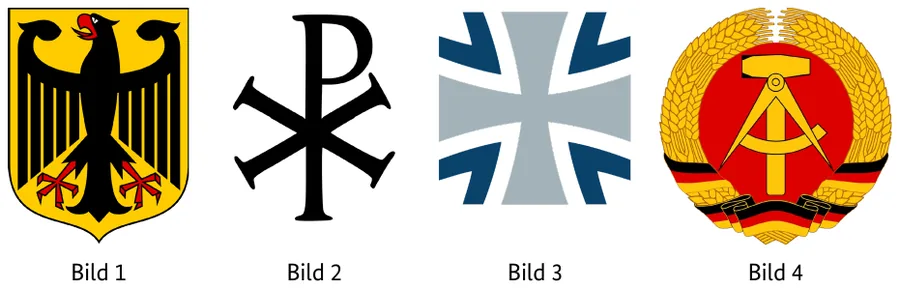
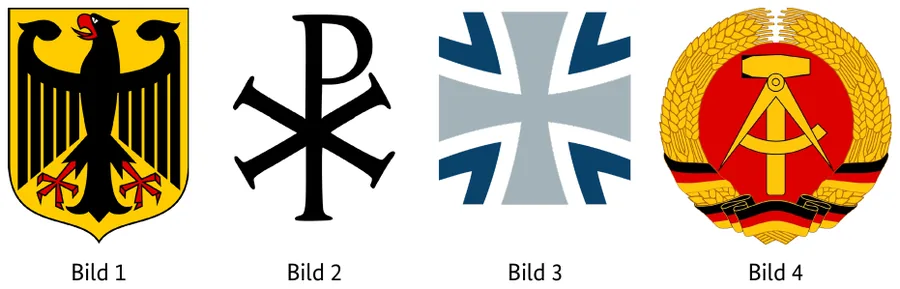
The correct answer is picture 1: the black federal eagle (Bundesadler) with red claws and beak on a gold shield. That is the federal coat of arms (Bundeswappen); the other pictures show a Christian symbol, the Iron Cross of the Bundeswehr (armed forces) and the coat of arms of the former GDR.
Germany is a republic: the head of state is an elected Bundespräsident (Federal President), not a monarch (Article 20 of the Grundgesetz, the Basic Law). The monarchy in Germany ended in 1918.
Elsass-Lothringen (Alsace-Lorraine) is a region in France, not a German Bundesland (federal state). It belonged to the German Empire only from 1871 to 1918.
B ein demokratischer und sozialer Bundesstaat.✓ correct
C eine kapitalistische und soziale Monarchie.
D ein sozialer und sozialistischer Bundesstaat.
Explication (EUpassway, non officielle)
Article 20 of the Grundgesetz (Basic Law) states that Germany is a democratic and social federal state (Bundesstaat). It is neither communist nor socialist, nor a monarchy.
Germany is a federal state (Bundesstaat): power is shared between the federation (Bund) and the 16 states (federalism). It is not a dictatorship, a monarchy or a socialist state.
Members of the Bundestag (federal parliament) are elected by the people, i.e. all citizens entitled to vote (Article 38 of the Grundgesetz). In federal elections you may vote from age 18 if you have German citizenship.
The heraldic animal of the Federal Republic is the eagle, called the Bundesadler (federal eagle). You can see it for example in the Bundestag's plenary hall and on German euro coins.
Press censorship is not a feature of democracy: Article 5 of the Grundgesetz (Basic Law) explicitly says there shall be no censorship. Regular elections, free speech and several parties are features of democracy.
When no party has a majority on its own, several parties form a Koalition (coalition) to govern together. A Fraktion, by contrast, is the group of one party's members in parliament.
The three powers of the state are legislation (parliament), government/administration and the judiciary (courts). The press is free and independent of the state; it is sometimes called the fourth estate, but it is not a state power.
A sind Staat und Religionsgemeinschaften voneinander getrennt.✓ correct
B bilden die Religionsgemeinschaften den Staat.
C ist der Staat abhängig von den Religionsgemeinschaften.
D bilden Staat und Religionsgemeinschaften eine Einheit.
Explication (EUpassway, non officielle)
Germany has no state church; the state and religious communities are separate (Article 140 of the Grundgesetz, the Basic Law). The state is religiously neutral but cooperates with them in some areas, such as religious education in schools.
Germany is not a monarchy but a republic with an elected Bundespräsident (Federal President). Democracy, the rule of law and the welfare state are core principles under Article 20 of the Grundgesetz (Basic Law).
Social insurance is financed mainly through social contributions (Sozialabgaben): employees and employers pay contributions based on wages, topped up by tax-funded subsidies. Church tax, donations and club fees have nothing to do with it.
Health insurance (Krankenversicherung) is one of the five pillars of social insurance and protects against the costs of illness. Car, building and liability insurance are private insurances and not part of the social security system.
In 13 of the 16 Bundesländer (federal states) the head of government is called Ministerpräsident (minister-president). In the city-states of Berlin, Hamburg and Bremen the title is a form of Bürgermeister (mayor), e.g. Regierender Bürgermeister in Berlin.
Article 20 of the Grundgesetz (Basic Law) calls Germany a democratic and social Bundesstaat (federal state). This means the states are parts of one common state, not a loose confederation (Staatenbund) and not a centralised state.
A eine eigene Außenministerin/einen eigenen Außenminister
B eine eigene Währung
C eine eigene Armee
D eine eigene Regierung✓ correct
Explication (EUpassway, non officielle)
Each Bundesland (federal state) has its own government, its own parliament (Landtag) and its own constitution. Foreign policy, the army and the currency are matters for the federal level or the EU.
The national anthem is the third verse of the Lied der Deutschen by Hoffmann von Fallersleben (1841), set to music by Joseph Haydn. It begins Einigkeit und Recht und Freiheit (Unity and justice and freedom). Freude schöner Götterfunken is the European anthem, and Deutschland einig Vaterland comes from the GDR anthem.
A weil dadurch die unterschiedlichen Meinungen der Bürgerinnen und Bürger vertreten werden✓ correct
B damit Bestechung in der Politik begrenzt wird
C um politische Demonstrationen zu verhindern
D um wirtschaftlichen Wettbewerb anzuregen
Explication (EUpassway, non officielle)
In a democracy people have different opinions and interests. Having several parties ensures these views are represented in parliament and voters have a real choice.
New federal laws are passed by parliament, i.e. the Bundestag (federal parliament), with participation of the Bundesrat (council of the states). The government can only propose laws, courts apply them and the police enforce them.
A party can be banned if it actively fights against the free democratic basic order (Article 21 of the Grundgesetz, the Basic Law). Only the Bundesverfassungsgericht (Federal Constitutional Court) decides this; criticism or new ideas are allowed.
B Die Bundespräsidentin/den Bundespräsidenten✓ correct
C Landtagsabgeordnete
D Bundestagsabgeordnete
Explication (EUpassway, non officielle)
The Bundespräsident (Federal President) is not elected by the people but by the Bundesversammlung (Federal Convention), as set out in Article 54 of the Grundgesetz. Members of the Bundestag, the state parliaments and the European Parliament are elected directly.
Long-term care insurance (Pflegeversicherung) was introduced in 1995. Together with health, pension, unemployment and accident insurance it is one of the five pillars of statutory social insurance (Sozialversicherung).
C Er versorgt alle Einwohnerinnen und Einwohner kostenlos mit Zeitungen.
D Er produziert Autos und Busse.
Explication (EUpassway, non officielle)
The state provides public infrastructure such as roads and schools, paid for with taxes. Food, clothing, cars and newspapers are produced and sold by private companies.
Constitutional organs (Verfassungsorgane) are the highest bodies named in the Grundgesetz (Basic Law): Bundestag, Bundesrat, Bundespräsident, the federal government, the Federal Constitutional Court and the Bundesversammlung. A Bürgerversammlung (citizens' meeting) is a local event and not a constitutional organ.
In Germany, schools and education are the responsibility of the Bundesländer (federal states), known as the states' cultural sovereignty (Kulturhoheit). That is why each state has its own school laws and curricula.
Germany has a social market economy (soziale Marktwirtschaft): the market sets supply and prices, while the state ensures social balance and protection. It was introduced after 1948, mainly by Ludwig Erhard; the GDR had a planned economy.
A Menschen sich kritisch über die Regierung äußern können.
B Bürger friedlich demonstrieren gehen dürfen.
C Menschen von einer Privatpolizei ohne Grund verhaftet werden.✓ correct
D jemand ein Verbrechen begeht und deshalb verhaftet wird.
Explication (EUpassway, non officielle)
In a state under the rule of law only the state police may arrest people, and only with a legal reason; a judge must decide on any longer detention (Article 104 of the Grundgesetz). A private police force arresting people without reason is incompatible with this.
Article 20 of the Grundgesetz (Basic Law) says: all state authority comes from the people (Alle Staatsgewalt geht vom Volke aus). The people exercise this power mainly through elections.
C Die Bürgerinnen und Bürger entscheiden über Gesetze.
D Der Staat muss die Gesetze einhalten.✓ correct
Explication (EUpassway, non officielle)
Rechtsstaat (rule of law) means the state itself is bound by law (Article 20 of the Grundgesetz, the Basic Law), and its decisions can be reviewed by independent courts. So the state is not automatically right.
The three powers are the Legislative (law-making), the Executive (carrying out laws) and the Judiciary (Judikative, the courts). There is no state power called Direktive.
The Ordnungsamt (public order office) is part of the town or municipal administration and deals with things like illegal parking, noise and public order. The Finanzamt (tax office) is a state authority, the Auswärtiges Amt is the federal foreign ministry and the Pfarramt belongs to the church.
B die Ministerpräsidentin/der Ministerpräsident des größten Bundeslandes
C eine ehemalige Bundeskanzlerin/ein ehemaliger Bundeskanzler
D eine Abgeordnete/ein Abgeordneter der stärksten Fraktion✓ correct
Explication (EUpassway, non officielle)
By tradition, the largest parliamentary group (Fraktion) provides the President of the Bundestag (federal parliament). All members elect the president at the start of the legislative term.
A die Präsidentin/der Präsident des Bundesverfassungsgerichtes
B die Bundespräsidentin/der Bundespräsident✓ correct
C die Bundesratspräsidentin/der Bundesratspräsident
D die Bundestagspräsidentin/der Bundestagspräsident
Explication (EUpassway, non officielle)
The Bundespräsident (Federal President) appoints the federal ministers on the proposal of the Bundeskanzler (Federal Chancellor), as set out in Article 64 of the Grundgesetz. So the chancellor chooses them, and the president formally appoints them.
A decree by the Roman emperor Constantine from the year 321 mentions a Jewish community in Cologne. That was about 1700 years ago, which is why 1700 years of Jewish life in Germany were celebrated in 2021.
The Bundestag (federal parliament) and the Bundesrat (council of the states) pass federal laws and therefore belong to the Legislative (law-making power). The Executive carries out laws, and the Judiciary (Judikative) means the courts.
B Das Bundesverfassungsgericht steht über der Verfassung.
C Die Interessenverbände üben die Souveränität zusammen mit der Regierung aus.
D Die Staatsgewalt geht vom Volke aus.✓ correct
Explication (EUpassway, non officielle)
Volkssouveränität (popular sovereignty) means that all state authority comes from the people (Article 20 of the Grundgesetz, the Basic Law). Supreme power lies not with a king or a court but with the citizens, mainly through elections.
The parliament of a Bundesland (federal state) is called the Landtag, so its election is a Landtagswahl (state election). In the city-states it is called Abgeordnetenhaus (Berlin) or Bürgerschaft (Hamburg, Bremen).
Courts belong to the Judiciary (Judikative) and are independent. The police, the tax office (Finanzamt) and ministries carry out laws and belong to the Executive (Exekutive).
Germany has three levels: the federation (Bund), the 16 states (Länder) and local authorities (Kommunen: towns, municipalities and districts). Occupation zones existed only after 1945, and cantons are found in Switzerland.
C die Bundeskanzlerin/den Bundeskanzler zu wählen.
D das Bundeskabinett zu bilden.✓ correct
Explication (EUpassway, non officielle)
The federal cabinet (Bundeskabinett) is formed by the Bundeskanzler (Federal Chancellor), who chooses the ministers; the Bundespräsident appoints them. The Bundestag makes laws, scrutinises the government and elects the chancellor.
Germany's largest Jewish communities are in Berlin and Munich (München), each with roughly 9,000 members. Worms and Speyer have a very old Jewish history but only small communities today.
School policy is mainly the responsibility of the Bundesländer (federal states), known as their cultural sovereignty (Kulturhoheit). Defence and foreign policy are federal matters.
A weil es in Deutschland nur staatliche Schulen gibt
B weil alle Schülerinnen und Schüler einen Schulabschluss haben müssen
C weil es in den Bundesländern verschiedene Schulen gibt
D weil es nach dem Grundgesetz seine Aufgabe ist✓ correct
Explication (EUpassway, non officielle)
Article 7 of the Grundgesetz (Basic Law) says the entire school system is under state supervision. Private schools also exist, but they need approval and are supervised.
The administration has three levels: the federation (Bund), the states (Länder) and the municipalities (Gemeinden). The Gemeinden are the lowest level and manage local affairs themselves (Article 28 of the Grundgesetz).
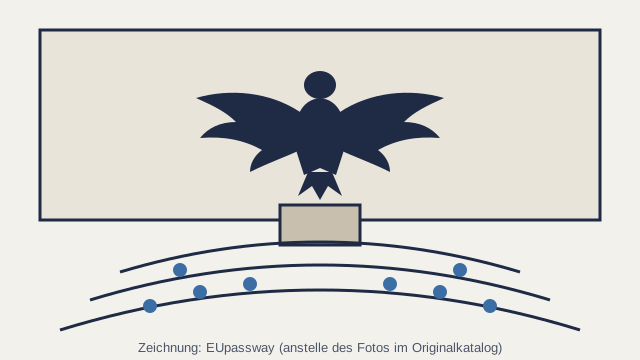
Le catalogue original montre ici une photo de presse ; elle n’est pas reproduite. Le texte suffit pour répondre.
A Sie/Er führt die Regierungsgeschäfte.
B Sie/Er kontrolliert die Regierungspartei.
C Sie/Er wählt die Ministerinnen/Minister aus.
D Sie/Er schlägt die Kanzlerin/den Kanzler zur Wahl vor.✓ correct
Explication (EUpassway, non officielle)
The Bundespräsident (Federal President) proposes a candidate to the Bundestag for election as Bundeskanzler (chancellor), as set out in Article 63 of the Grundgesetz, and appoints the person after the vote. The chancellor runs the government and chooses the ministers.
A in Bonn, weil sich dort das Bundeskanzleramt und der Bundestag befinden.
B auf Schloss Meseberg, dem Gästehaus der Bundesregierung, um Staatsgäste zu empfangen.
C auf Schloss Bellevue, dem Amtssitz der Bundespräsidentin/des Bundespräsidenten, um Staatsgäste zu empfangen.
D in Berlin, weil sich dort das Bundeskanzleramt und der Bundestag befinden.✓ correct
Explication (EUpassway, non officielle)
The Federal Chancellery (Bundeskanzleramt) and the Bundestag are in Berlin, so the chancellor mostly works there. Bonn was the seat of government until 1999, and Schloss Bellevue is the seat of the Bundespräsident (Federal President).
Friedrich Merz (CDU) was elected Bundeskanzler (Federal Chancellor) by the Bundestag in May 2025. In general, the Bundestag elects the chancellor after each federal election; Merkel and Schröder were earlier chancellors, and Ursula von der Leyen heads the European Commission.
After the federal election in February 2025, CDU/CSU is the largest and the AfD the second-largest parliamentary group (Fraktion) in the Bundestag. This ranking can change after any election.
The parliament for all of Germany is the Bundestag in Berlin, elected every four years. The Volkskammer was the parliament of the GDR, and the Bundesversammlung (Federal Convention) only elects the Federal President.
The head of state is the Bundespräsident (Federal President); since 2017 this has been Frank-Walter Steinmeier, re-elected in 2022. A term lasts five years, with at most two terms; Joachim Gauck was his predecessor.
The Bundeswehr is the armed forces of the Federal Republic of Germany, founded in 1955. It is a parliamentary army: deployments abroad need the approval of the Bundestag. The police are a separate institution.
C Sozialdemokratische Partei Deutschlands✓ correct
D Sozialgerechte Partei Deutschlands
Explication (EUpassway, non officielle)
SPD stands for Sozialdemokratische Partei Deutschlands (Social Democratic Party of Germany). It is Germany's oldest party, with roots going back to 1863.
The Bundesverfassungsgericht (Federal Constitutional Court) in Karlsruhe gives the binding interpretation of the Grundgesetz (Basic Law) and checks whether laws are constitutional. Local, higher regional and administrative courts handle other legal matters.
The Bundeskanzler (Federal Chancellor) is elected by the Bundestag (federal parliament) on the proposal of the Federal President (Article 63 of the Grundgesetz). The people do not elect the chancellor directly, and the Bundesversammlung only elects the Federal President.
A die Bundestagspräsidentin/der Bundestagspräsident
B die Bundespräsidentin/der Bundespräsident
C die Bundesratspräsidentin/der Bundesratspräsident
D die Bundeskanzlerin/der Bundeskanzler✓ correct
Explication (EUpassway, non officielle)
The federal cabinet (Bundeskabinett) consists of the Bundeskanzler (Federal Chancellor) and the federal ministers. The chancellor leads it and sets the general policy guidelines (Article 65 of the Grundgesetz).
The Bundestag (federal parliament) elects the Bundeskanzler (Federal Chancellor) with a majority of its members (Article 63 of the Grundgesetz). In the federal election the people only elect the members of parliament, not the chancellor directly.
The main task of the Bundespräsident (Federal President) is to represent Germany at home and abroad, for example on state visits. The president also signs laws but does not govern; that is the job of the federal government.
B die Ministerinnen und Minister der Bundesregierung
C die Regierungsvertreter der Bundesländer✓ correct
D die Parteimitglieder
Explication (EUpassway, non officielle)
The Bundesrat (council of the states) is made up of members of the state governments (Article 51 of the Grundgesetz). Each state has 3 to 6 votes depending on its population, 69 in total.
The Bundesversammlung (Federal Convention) elects the Bundespräsident (Federal President) for five years (Article 54 of the Grundgesetz). It consists of all members of the Bundestag plus an equal number of delegates chosen by the state parliaments, and meets only for this election.
B die Bundespräsidentin/der Bundespräsident✓ correct
C die Bundesratspräsidentin/der Bundesratspräsident
D die Bundestagspräsidentin/der Bundestagspräsident
Explication (EUpassway, non officielle)
The head of state is the Bundespräsident (Federal President). The Bundeskanzler (Federal Chancellor), by contrast, heads the government and has more political power.
B entscheidet, wer Bundesministerin/Bundesminister wird.
C bestimmt, wer im Bundesrat sitzt.
D schlägt die Regierungschefinnen/Regierungschefs der Länder vor.
Explication (EUpassway, non officielle)
The opposition scrutinises and criticises the government, for example through parliamentary questions, debates and committees of inquiry. Ministers are chosen by the chancellor, and the Bundesrat is made up of the state governments.
Through the Bundesrat (council of the states) the Länder take part in federal legislation and administration (Article 50 of the Grundgesetz). Some laws that particularly affect the states need the Bundesrat's consent.
A schwieriger, wenn sich dadurch die Mehrheit im Bundestag ändert.
B leichter, wenn dadurch neue Parteien in den Bundesrat kommen.
C schwieriger, wenn dadurch die Mehrheit im Bundesrat verändert wird.✓ correct
D leichter, wenn es sich um ein reiches Bundesland handelt.
Explication (EUpassway, non officielle)
After a state election the composition of the Bundesrat (council of the states) can change, because the state governments sit there. If the federal government loses its majority there, the Bundesrat can block laws that need its consent. A state election does not change the Bundestag.
CSU stands for Christlich-Soziale Union (Christian Social Union). It runs only in Bavaria and forms a joint parliamentary group with the CDU in the Bundestag (the Union).
B mehr Direktkandidaten der Partei ziehen ins Parlament ein.
C größer ist das Risiko, eine Koalition bilden zu müssen.
D mehr Sitze erhält die Partei im Parlament.✓ correct
Explication (EUpassway, non officielle)
The Zweitstimme (second vote, cast for a party list) is the decisive vote: the seats in the Bundestag (federal parliament) are shared out according to each party's share of second votes. More second votes therefore mean more seats; the Erststimme (first vote) only decides which person wins the local constituency.
Under Article 38 of the Grundgesetz (Basic Law, Germany's constitution) you may vote in the Bundestag election from age 18. Some federal states allow voting at 16 in local or state elections, but not for the Bundestag.
Germany has Schulpflicht (compulsory schooling): children must attend school for roughly 9 to 10 years. There is no compulsory voting and no religious obligation.
D mit Freiheitsstrafe bis zu fünf Jahren oder mit Geldstrafe✓ correct
Explication (EUpassway, non officielle)
Publicly denying the Holocaust is a crime under section 130 of the German Criminal Code (Volksverhetzung, incitement to hatred). The penalty is up to five years in prison or a fine.
In regular employment, contributions to the Sozialversicherung (social insurance: health, long-term care, pension and unemployment insurance) are deducted from your wages automatically. Social assistance, child benefit and housing benefit are payments you receive, not pay.
A dürfen sie nicht mehr an den Sitzungen des Parlaments teilnehmen.
B kann die Regierung ihre Mehrheit verlieren.✓ correct
C muss die Bundespräsidentin/der Bundespräsident zuvor ihr/sein Einverständnis geben.
D dürfen die Wählerinnen/Wähler dieser Abgeordneten noch einmal wählen.
Explication (EUpassway, non officielle)
A government needs a majority of members in the Bundestag. If members switch from a governing Fraktion (parliamentary group) to another one, that majority can be lost; they keep their seat, because under Article 38 of the Grundgesetz they are bound only by their conscience.
A Arbeitgeberinnen/Arbeitgeber und Arbeitnehmerinnen/Arbeitnehmer✓ correct
B nur Arbeitnehmerinnen/Arbeitnehmer
C alle Staatsangehörigen
D nur Arbeitgeberinnen/Arbeitgeber
Explication (EUpassway, non officielle)
Social insurance contributions are paid jointly by employers and employees, usually roughly half each. Only statutory accident insurance is paid by the employer alone.
Statutory social insurance consists of health, long-term care, pension, unemployment and accident insurance. Life insurance is a private, voluntary insurance.
Gewerkschaften (trade unions) represent the interests of employees, for example on pay and working hours. They negotiate collective agreements with employers; employers have their own employers' associations.
D Ehrentitel "Held der Deutschen Demokratischen Republik"
Explication (EUpassway, non officielle)
The Bundesverdienstkreuz (Order of Merit of the Federal Republic of Germany, since 1951) is the highest award for special achievements and is presented by the Federal President. The Patriotic Order of Merit and the title Hero of the GDR were awards of the former East Germany (DDR).
B von SPD, FDP und Bündnis 90/Die Grünen in einer Regierung✓ correct
C von CSU, Die LINKE und Bündnis 90/Die Grünen in einer Regierung
D der Bundestagsfraktionen von CDU und SPD
Explication (EUpassway, non officielle)
Ampelkoalition (traffic-light coalition) means a government of SPD (red), FDP (yellow) and the Greens (green), like the colours of a traffic light. At federal level such a coalition governed from 2021 to 2024.
C Die Frau erledigt private Sachen während der Arbeitszeit.
D Die Frau bekommt ein Kind und ihr Chef weiß das.✓ correct
Explication (EUpassway, non officielle)
Pregnant women and new mothers have special protection against dismissal under the Mutterschutzgesetz (Maternity Protection Act): pregnancy must never be the reason for dismissal. Frequent lateness, doing private things during work time or very long illness can, depending on the case, justify a dismissal.
A Sie helfen alten Menschen bei der Stimmabgabe in der Wahlkabine.
B Sie schreiben die Wahlbenachrichtigungen vor der Wahl.
C Sie geben Zwischenergebnisse an die Medien weiter.
D Sie zählen die Stimmen nach dem Ende der Wahl.✓ correct
Explication (EUpassway, non officielle)
Election volunteers (Wahlhelfer) work at the polling station and count the votes publicly after polls close at 6 pm. Polling cards are sent by the municipality, and you enter the voting booth alone because the vote is secret.
A Sie helfen Kindern und alten Menschen beim Wählen.
B Sie schreiben Karten und Briefe mit der Angabe des Wahllokals.
C Sie geben Zwischenergebnisse an Journalisten weiter.
D Sie zählen die Stimmen nach dem Ende der Wahl.✓ correct
Explication (EUpassway, non officielle)
Volunteer election helpers count the votes at the polling station after voting ends. They do not pass interim results to journalists, and they do not help people mark their ballot, except in special cases (e.g. disability) at the voter's own request.
A in der Bundesrepublik Deutschland wohnt und wählen möchte.
B Bürgerin/Bürger der Bundesrepublik Deutschland ist und mindestens 18 Jahre alt ist.✓ correct
C seit mindestens 3 Jahren in der Bundesrepublik Deutschland lebt.
D Bürgerin/Bürger der Bundesrepublik Deutschland ist und mindestens 21 Jahre alt ist.
Explication (EUpassway, non officielle)
Only German citizens aged 18 or over may vote in the Bundestag election (Article 38 of the Grundgesetz). Living in Germany is not enough; foreign nationals cannot vote, and EU citizens may vote only in local and European elections.
The Bundestag's term is four years (Article 39 of the Grundgesetz), so a federal election normally takes place every four years. Only if the Bundestag is dissolved early, as in 2025, is there an earlier election.
Under Article 39 of the Grundgesetz the Bundestag is elected for four years. Five-year terms apply, for example, to most state parliaments and the European Parliament, not to the Bundestag.
B das Aufhängen einer israelischen Flagge auf dem Privatgrundstück
C eine Diskussion über die Politik Israels
D der öffentliche Aufruf zur Vernichtung Israels✓ correct
Explication (EUpassway, non officielle)
Criticising or discussing Israel's policies is protected by freedom of expression, and so is hanging an Israeli flag. Publicly calling for the destruction of Israel, however, is a crime, for example as incitement to hatred (Volksverhetzung) or incitement to commit crimes.
Elections in Germany are secret (Article 38 of the Grundgesetz): nobody may see or check whom you vote for. That is why you mark your ballot alone in the voting booth.
C die meisten Stimmen bei den Arbeiterinnen/Arbeitern bekommen hat.
D die meisten Erststimmen für ihre Kanzlerkandidatin/ihren Kanzlerkandidaten erhalten hat.
Explication (EUpassway, non officielle)
The party with the most votes wins the election; for the Bundestag the second votes (Zweitstimmen) count. Every vote counts equally regardless of gender or job, and the Chancellor is not elected directly by the people but by the Bundestag.
Aktives Wahlrecht (active voting right) means you are allowed to vote. Being allowed to stand for election is called passives Wahlrecht (passive voting right).
The right to cast your vote in an election is called aktives Wahlrecht (active voting right). Wahlkampf and Wahlkampagne, by contrast, mean the parties' campaigning before an election.
A party needs at least 5% of the second votes nationwide to win seats in the Bundestag (the 5%-Hürde, five-percent threshold). The only exceptions are parties of national minorities and parties that win at least three constituencies directly.
A Alle verurteilten Straftäterinnen/Straftäter dürfen nicht wählen.
B Wenn ich wählen gehen möchte, muss meine Arbeitgeberin/mein Arbeitgeber mir frei geben.
C Jede Person kann ohne Zwang entscheiden, ob sie wählen möchte und wen sie wählen möchte.✓ correct
D Ich kann frei entscheiden, wo ich wählen gehen möchte.
Explication (EUpassway, non officielle)
A free election means nobody may force or pressure you about whether you vote or whom you vote for (Article 38 of the Grundgesetz). It is about a free choice, not about the place of voting or time off work.
In the Bundestag election you have two votes: with the first vote (Erststimme) you elect a person in your constituency by majority, with the second vote (Zweitstimme) you vote for a party by proportional representation. The system is therefore called personalised proportional representation, a mix of majority and proportional voting.
The minimum share needed to enter the Bundestag is called the 5%-Hürde (five-percent threshold, also Sperrklausel): a party needs at least 5% of the second votes. The other terms are not names for this rule.
Under Article 38 of the Grundgesetz elections are general, direct, free, equal and secret. Free, equal and secret are three of these principles; an open vote would not be secret.
A Abstimmungsregelung im Bundestag für kleine Parteien
B Anwesenheitskontrolle im Bundestag für Abstimmungen
C Mindestanteil an Wählerstimmen, um ins Parlament zu kommen✓ correct
D Anwesenheitskontrolle im Bundesrat für Abstimmungen
Explication (EUpassway, non officielle)
The 5%-Hürde (five-percent threshold) is the minimum share of votes: a party needs at least 5% of the second votes to get seats in parliament. It has nothing to do with votes or attendance in the Bundestag or Bundesrat (federal council of the states).
In the Bundestag election citizens elect the Bundestag, the parliament for the whole of Germany. The Chancellor is then elected by the Bundestag, and the Federal President by the Bundesversammlung (Federal Convention).
A die Bürgerinnen und Bürger zu zwingen, ihre Stimme abzugeben.
B nach dem Willen der Wählermehrheit den Wechsel der Regierung zu ermöglichen.✓ correct
C im Land bestehende Gesetze beizubehalten.
D den Armen mehr Macht zu geben.
Explication (EUpassway, non officielle)
Regular elections give citizens the chance to vote a government out and choose a different majority peacefully. Voting is voluntary, and elections are not meant to keep laws unchanged.
A eine Wahlbenachrichtigung von der Gemeinde✓ correct
B eine Wahlerlaubnis von der Bundespräsidentin/von dem Bundespräsidenten
C eine Benachrichtigung von der Bundesversammlung
D eine Benachrichtigung vom Pfarramt
Explication (EUpassway, non officielle)
Before an election the municipality (Gemeinde) sends every eligible voter a Wahlbenachrichtigung (polling card). It shows your polling station and the election date, and you can also use it to apply for a postal vote.
A die Programme von vielen kleinen Parteien viele Gemeinsamkeiten haben.
B die Bürgerinnen und Bürger bei vielen kleinen Parteien die Orientierung verlieren können.
C viele kleine Parteien die Regierungsbildung erschweren.✓ correct
D die kleinen Parteien nicht so viel Geld haben, um die Politikerinnen und Politiker zu bezahlen.
Explication (EUpassway, non officielle)
The five-percent threshold is meant to prevent a very large number of small parties from sitting in parliament. That would make it hard to form a stable majority and a government, as seen in the Weimar Republic.
Elected members of a parliament are called Abgeordnete (members of parliament); in the Bundestag they are MdB. Chancellors, ambassadors and state premiers are not directly elected by the people.
B die Ministerpräsidentin/der Ministerpräsident eines Bundeslandes.
C der Bundestag.✓ correct
D die Bundespräsidentin/der Bundespräsident.
Explication (EUpassway, non officielle)
The people directly elect the Bundestag. The Chancellor is elected by the Bundestag, state premiers by the state parliaments (Landtage), and the Federal President by the Bundesversammlung (Federal Convention).
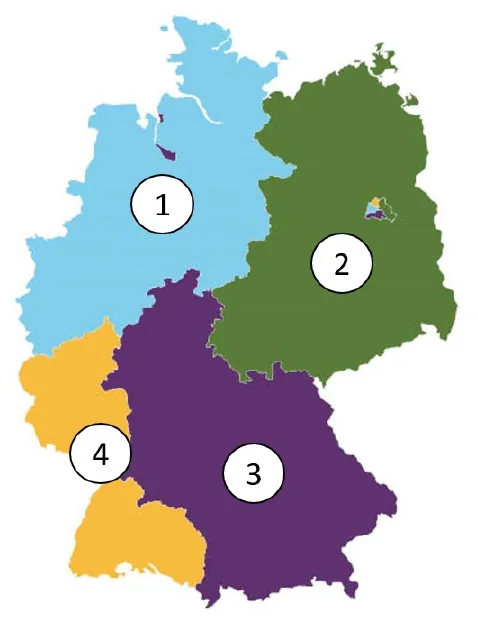
Ballot 1 is valid: it has exactly one cross for the Erststimme (first vote, left column, a candidate) and exactly one cross for the Zweitstimme (second vote, right column, a party). Splitting the two votes between different parties is allowed; the other ballots have two or more crosses in one column.
B Sie arbeiten freiwillig und unbezahlt in Vereinen und Verbänden.✓ correct
C Sie arbeiten in der Bundesregierung.
D Sie arbeiten in einem Krankenhaus und verdienen dabei Geld.
Explication (EUpassway, non officielle)
Ehrenamtlich means voluntary and unpaid, for example in a sports club, the volunteer fire brigade or social organisations. If you are paid for your work, it is not ehrenamtlich.
B Man kann durch Briefwahl seine Stimme abgeben.✓ correct
C Man kann am Wahltag telefonisch seine Stimme abgeben.
D Kinder ab dem Alter von 14 Jahren dürfen wählen.
Explication (EUpassway, non officielle)
If you cannot go to the polling station on election day, you can vote by Briefwahl (postal vote), which you request from your municipality. You must vote yourself: nobody may vote for another person, voting by phone is not possible, and 14-year-olds cannot vote.
A Ich beteilige mich an einer Bürgerinitiative für die Erhaltung der Buslinie oder gründe selber eine Initiative.✓ correct
B Ich werde Mitglied in einem Sportverein und trainiere Radfahren.
C Ich wende mich an das Finanzamt, weil ich als Steuerzahlerin/Steuerzahler ein Recht auf die Buslinie habe.
D Ich schreibe einen Brief an das Forstamt der Gemeinde.
Explication (EUpassway, non officielle)
A Bürgerinitiative (citizens' initiative) is a group of residents who campaign for a specific local goal, such as keeping a bus line. This is a typical form of political participation; the tax office or forestry office has nothing to do with it.
B ungerechtfertigter Kündigung durch Ihre Chefin/Ihren Chef.✓ correct
C Problemen mit den Nachbarinnen/Nachbarn.
D Schwierigkeiten nach einem Verkehrsunfall.
Explication (EUpassway, non officielle)
The Arbeitsgericht (labour court) handles disputes between employees and employers, for example an unjustified dismissal. Disputes with neighbours, over service charges or after a traffic accident go to other courts, usually the Amtsgericht (local court).
Conflicts at work, for example about pay, holidays or dismissal, are handled by the Arbeitsgericht (labour court). Family courts deal with family matters and criminal courts with crimes.
A weiterarbeiten und freundlich zur Chefin/zum Chef sein
B ein Mahnverfahren gegen die Arbeitgeberin/den Arbeitgeber führen
C Kündigungsschutzklage erheben✓ correct
D die Arbeitgeberin/den Arbeitgeber bei der Polizei anzeigen
Explication (EUpassway, non officielle)
Against an unjustified dismissal you can file a Kündigungsschutzklage (unfair-dismissal claim) at the labour court, within three weeks of receiving the notice. The police are not responsible for this, and a Mahnverfahren (payment-order procedure) is only for collecting money.
B eine Straftat begangen hat und angeklagt wird.✓ correct
C eine andere Meinung als die der Regierung vertritt.
D sein Auto falsch geparkt hat und es abgeschleppt wird.
Explication (EUpassway, non officielle)
A criminal trial takes place when someone is accused of a crime and the public prosecutor brings charges. Changing religion and holding a different opinion are protected by the Grundgesetz, and wrong parking is only an administrative offence.
A entscheidet mit Richterinnen/Richtern über Schuld und Strafe.✓ correct
B gibt Bürgerinnen/Bürgern rechtlichen Rat.
C stellt Urkunden aus.
D verteidigt die Angeklagte/den Angeklagten.
Explication (EUpassway, non officielle)
Schöffen are lay judges without legal training. In criminal trials they decide on guilt and sentence together with professional judges, with an equal vote.
A Rechtsanwalt (lawyer/attorney) advises people on legal questions and represents them in court. Judges decide neutrally, and the Staatsanwalt (public prosecutor) brings criminal charges.
A vertritt Bürgerinnen und Bürger vor einem Gericht.
B arbeitet an einem Gericht und spricht Urteile.✓ correct
C ändert Gesetze.
D betreut Jugendliche vor Gericht.
Explication (EUpassway, non officielle)
Judges work at courts, conduct proceedings and deliver judgments. They are independent and bound only by the law (Article 97 of the Grundgesetz); only parliament may change laws.
Separation of powers distinguishes the Legislative (making laws), the Executive (carrying out laws) and the Judikative (judiciary, administering justice). Judges belong to the Judikative.
The rechtsprechende Gewalt (judicial power) lies with the courts, i.e. the judges (Article 92 of the Grundgesetz). The legislative power is parliament; the executive power is the government and administration.
Proceedings before a court are called a Prozess (trial/lawsuit), e.g. Strafprozess (criminal trial) or Zivilprozess (civil case). A Protokoll is only the written record of it.
A judge's job is Recht sprechen (to administer justice), i.e. to decide disputes and criminal cases according to the law. Governing is the government's task, and parliament passes the laws.
D die Einhaltung von Gesetzen zu überwachen✓ correct
Explication (EUpassway, non officielle)
The police maintain public safety and order and monitor that laws are obeyed. The Bundeswehr (armed forces) defends the country, parliament passes laws, and citizens may be wiretapped only within narrow legal limits with a court order.
Denying the Holocaust is antisemitic because it plays down the murder of about six million Jews; in Germany it is also a crime. Factual criticism of the Israeli government, by contrast, is not automatically antisemitic.
The DDR (German Democratic Republic, East Germany) built the Berlin Wall from 13 August 1961 to stop its citizens fleeing to West Berlin. It stood until it fell on 9 November 1989.
Hitler became Reich Chancellor on 30 January 1933, after which the National Socialists set up a dictatorship. Their rule ended with Germany's surrender in May 1945.
On 8 May 1945 the unconditional surrender of the German armed forces took effect, ending the Second World War in Europe. Hitler had already died on 30 April 1945; the Wall was built in 1961 and Adenauer was elected in 1949.
The Second World War ended in 1945: in Europe on 8 May, in Asia with Japan's surrender in September. 1933 is when Hitler took power, 1949 when the two German states were founded, and 1961 when the Wall was built.
The National Socialists ruled Germany from 1933 to 1945. Their rule began with Hitler's appointment as Reich Chancellor in January 1933 and ended with the surrender in May 1945.
From 1933 the National Socialists abolished democracy: parties were banned, basic rights suspended and opponents persecuted. This created a dictatorship under Hitler.
Drittes Reich (Third Reich) was the name the National Socialists gave their state from 1933 to 1945. It was a dictatorship with only one permitted party, no free elections and no basic rights.
There were no free elections in the Nazi era, because from July 1933 the NSDAP was the only permitted party. Press censorship, arbitrary arrests and the persecution of Jews, however, did exist.
The Nazi state made racism official state policy: Jews, Sinti and Roma and other groups were stripped of rights, persecuted and murdered. Freedom of opinion, freedom of religion and democracy did not exist.
A eine Goldmedaille bei den Olympischen Spielen 1936.
B den Bau des Reichstagsgebäudes.
C den Aufbau der Wehrmacht.
D das Attentat auf Hitler am 20. Juli 1944.✓ correct
Explication (EUpassway, non officielle)
Claus Schenk Graf von Stauffenberg was an army officer who set off a bomb at Hitler's headquarters on 20 July 1944 to kill Hitler and overthrow the Nazi regime. Hitler survived and Stauffenberg was shot that same night; he is a symbol of the resistance.
In the night of 9 to 10 November 1938 (the Novemberpogrome, November pogroms, formerly also called Kristallnacht), Nazis across the country destroyed synagogues and Jewish shops. Many Jews were abused, killed or taken to concentration camps.
A Mit dem Angriff auf Polen beginnt der Zweite Weltkrieg.
B Die Nationalsozialisten verlieren eine Wahl und lösen den Reichstag auf.
C Jüdische Geschäfte und Synagogen werden durch Nationalsozialisten und ihre Anhänger zerstört.✓ correct
D Hitler wird Reichspräsident und lässt alle Parteien verbieten.
Explication (EUpassway, non officielle)
On 9 November 1938 the November pogroms began: Nazis and their supporters destroyed synagogues and Jewish shops. The attack on Poland came later, on 1 September 1939.
Konrad Adenauer (CDU) became the first Bundeskanzler (Federal Chancellor) of the Federal Republic in 1949 and governed until 1963. Kiesinger, Brandt and Schmidt were chancellors later.
B bei den Demonstrationen 1968 in der Bundesrepublik Deutschland
C bei den Anti-Atomkraft-Demonstrationen 1985 in der Bundesrepublik Deutschland
D bei den Montagsdemonstrationen 1989 in der DDR✓ correct
Explication (EUpassway, non officielle)
Wir sind das Volk (We are the people) was chanted in 1989 at the Montagsdemonstrationen (Monday demonstrations) in East Germany, especially in Leipzig. These peaceful protests led to the fall of the Wall and the end of the SED dictatorship.
D USA, Sowjetunion, Großbritannien, Frankreich✓ correct
Explication (EUpassway, non officielle)
After 1945 the four victorious powers, the USA, the Soviet Union, Britain and France, divided Germany into four occupation zones. Italy and Japan had been Germany's allies, and Poland, Sweden, Spain and Portugal were not occupying powers.
Japan was Germany's ally in the Second World War, not an occupying power. The four occupying powers were the USA, the Soviet Union, Britain and France.
The Federal Republic of Germany was founded in 1949: the Grundgesetz (Basic Law) was proclaimed on 23 May 1949. In the same year, on 7 October, the DDR (East Germany) was founded in the east.
B das Recht zur freien Entfaltung der Persönlichkeit
C Pressefreiheit
D den Schutz der Menschenwürde
Explication (EUpassway, non officielle)
In the Nazi era all parties except the NSDAP were banned or forced to dissolve. Freedom of the press, free development of personality and protection of human dignity were only guaranteed by the Grundgesetz of 1949.
B wird vom Staat geplant und gesteuert, Angebot und Nachfrage werden nicht berücksichtigt.
C richtet sich nach der Nachfrage im Ausland.
D richtet sich nach Angebot und Nachfrage, aber der Staat sorgt für einen sozialen Ausgleich.✓ correct
Explication (EUpassway, non officielle)
In the Soziale Marktwirtschaft (social market economy) supply and demand drive the economy, but the state ensures social balance, e.g. through social insurance, worker protection and competition rules. A pure planned economy as in East Germany is the opposite.
The DDR (East Germany) was founded on 7 October 1949 in the Soviet occupation zone. The Federal Republic was formed from the American, British and French zones.
In 1951 and 1957 the Federal Republic was one of the six founding states of the European Communities, which developed into the EU. It joined NATO only in 1955 and the United Nations in 1973; the Warsaw Pact was the Eastern bloc's alliance.
The DDR (East Germany) was founded on 7 October 1949, a few months after the Federal Republic (23 May 1949). 1953 was the year of the popular uprising in East Germany.
A 1=Großbritannien, 2=Sowjetunion, 3=Frankreich, 4=USA
B 1=Sowjetunion, 2=Großbritannien, 3=USA, 4=Frankreich
C 1=Großbritannien, 2=Sowjetunion, 3=USA, 4=Frankreich✓ correct
D 1=Großbritannien, 2=USA, 3=Sowjetunion, 4=Frankreich
Explication (EUpassway, non officielle)
On the map, 1 is the north-west (British zone), 2 the east (Soviet zone), 3 the south with Bavaria and Hesse (American zone) and 4 the small south-west (French zone). Memory aid: the Soviets had the east, France the part along the French border.
Berlin lay in the middle of the Soviet zone but, as the capital, was divided into four sectors: American, British, French and Soviet. The three western sectors later formed West Berlin.
A Für Frankreich war eine Versorgung der West-Berliner Bevölkerung mit dem Flugzeug kostengünstiger.
B Die amerikanischen Soldatinnen und Soldaten hatten beim Landtransport Angst vor Überfällen.
C Für Großbritannien war die Versorgung über die Luftbrücke schneller.
D Die Sowjetunion unterbrach den gesamten Verkehr auf dem Landwege.✓ correct
Explication (EUpassway, non officielle)
In June 1948 the Soviet Union blocked all land and water routes to West Berlin (the Berlin Blockade). The Western Allies therefore supplied the city by plane for almost a year via the Luftbrücke (airlift).
B durch die bedingungslose Kapitulation Deutschlands✓ correct
C mit dem Rückzug der Deutschen aus den besetzten Gebieten
D durch eine Revolution in Deutschland
Explication (EUpassway, non officielle)
The war in Europe officially ended with the unconditional surrender of the German armed forces, which took effect on 8 May 1945. Hitler's death on 30 April 1945 did not yet end the war.
Konrad Adenauer was the first Federal Chancellor, from 1949 to 1963. Ludwig Erhard succeeded him in 1963; Willy Brandt and Gerhard Schröder were chancellors later.
Le catalogue original montre ici une photo de presse ; elle n’est pas reproduite. Le texte suffit pour répondre.
A Er hat sich den ehemaligen Alliierten unterworfen.
B Er bat Polen und die polnischen Juden um Vergebung.✓ correct
C Er zeigte seine Demut vor dem Warschauer Pakt.
D Er sprach ein Gebet am Grab des Unbekannten Soldaten.
Explication (EUpassway, non officielle)
On 7 December 1970 Chancellor Willy Brandt knelt before the memorial to the heroes of the Warsaw Ghetto. The gesture was understood as a plea for forgiveness for German crimes against Poland and Polish Jews.
The Wirtschaftswunder (economic miracle) was the rapid economic boom in West Germany in the 1950s. It was based on, among other things, the 1948 currency reform, the social market economy and Marshall Plan aid.
The basis was the UN partition plan for Palestine, United Nations Resolution 181 of 29 November 1947. On this basis the State of Israel was proclaimed on 14 May 1948.
The "Eiserner Vorhang" (Iron Curtain) was the heavily guarded border that sealed off the communist states of the East (later the Warsaw Pact) from the West. It divided Europe during the Cold War until 1989.
On 17 June 1953 there was a popular uprising in the DDR (East Germany) against the SED government, which Soviet tanks crushed. In West Germany, 17 June was a public holiday called "Day of German Unity" until 1990.
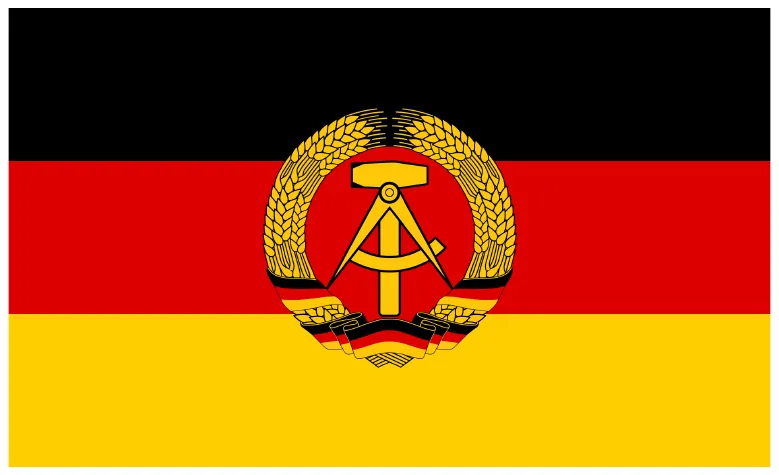
The flag of the DDR (East Germany) was black-red-gold like West Germany's, but from 1959 it carried the state emblem with hammer, compass and a wreath of wheat ears in the middle. The Federal Republic uses the colours without an emblem.
The Berlin Wall was built on 13 August 1961. 1990 is the year of reunification; 1919 and 1933 belong to the Weimar Republic and the start of the Nazi era.
DDR stands for "Deutsche Demokratische Republik" (German Democratic Republic). That was the name of the East German state from 1949 to 1990, although it was not a real democracy.
On 9 November 1989 the Wall in Berlin was opened after peaceful protests by people in the DDR (East Germany). Reunification followed a year later, in 1990.
Brandenburg surrounds Berlin and was part of the DDR (East Germany). It is one of the five "new federal states"; Bavaria, Saarland and Hesse were always part of West Germany.
From 1961 to 1989 the Wall divided Berlin into East Berlin (DDR) and West Berlin. West Berlin could also be reached by road and rail, not only by plane.
3 October is the "Tag der Deutschen Einheit" (Day of German Unity), a national holiday. On this day in 1990 the DDR (East Germany) joined the Federal Republic.
Saxony-Anhalt (Sachsen-Anhalt) was part of the DDR (East Germany) and is one of the five new federal states. Hesse, North Rhine-Westphalia and Saarland are in the West.
B von einer liberalen Marktwirtschaft zum Sozialismus.
C von einer Monarchie zur Sozialdemokratie.
D von einem religiösen Staat zu einem kommunistischen Staat.
Explication (EUpassway, non officielle)
"Wende" means turnaround: in autumn 1989 peaceful protests ended the SED dictatorship. The DDR became democratic, and in 1990 the first free election to its parliament (Volkskammer) took place.
Thuringia (Thüringen) was part of the DDR (East Germany) and is one of the five new federal states. Hesse, Bavaria and Bremen were always West German states.
"Stasi" is short for the DDR's Ministry for State Security (Ministerium für Staatssicherheit). It spied on citizens and persecuted people who opposed the ruling SED party.
Mecklenburg-Western Pomerania (Mecklenburg-Vorpommern) on the Baltic coast was part of the DDR (East Germany). Schleswig-Holstein is also in the north but was always part of West Germany.
A Niedersachsen, Nordrhein-Westfalen, Hessen, Schleswig-Holstein, Brandenburg
B Mecklenburg-Vorpommern, Brandenburg, Sachsen, Sachsen-Anhalt, Thüringen✓ correct
C Bayern, Baden-Württemberg, Rheinland-Pfalz, Thüringen, Sachsen
D Sachsen, Thüringen, Hessen, Niedersachen, Brandenburg
Explication (EUpassway, non officielle)
The five new federal states from the former DDR (East Germany) are Mecklenburg-Vorpommern, Brandenburg, Sachsen, Sachsen-Anhalt and Thüringen. The other lists always include at least one West German state, e.g. Hesse or Bavaria.
In the Cold War the DDR (East Germany) belonged to the Eastern Bloc led by the Soviet Union and was a member of the Warsaw Pact. West Germany, by contrast, belonged to NATO.
In the DDR (East Germany) the state planned the economy centrally and decided production and prices. This is called a planned economy (Planwirtschaft); West Germany has a social market economy instead.
B Die heutigen fünf östlichen Bundesländer sind der Bundesrepublik Deutschland beigetreten.✓ correct
C Die westlichen Bundesländer sind der DDR beigetreten.
D Die DDR hat die Bundesrepublik Deutschland besetzt.
Explication (EUpassway, non officielle)
The DDR was not occupied: its freely elected parliament (Volkskammer) decided to join under Article 23 of the Grundgesetz (Basic Law, Germany's constitution). On 3 October 1990 the five new states (and East Berlin) became part of the Federal Republic.
West Germany was already a member of the European Community. With accession in 1990 the new states automatically became part of it, i.e. today's European Union (EU, since 1993). The Warsaw Pact dissolved in 1991.
A an berühmte deutsche Politikerinnen und Politiker
B an die Opfer des Nationalsozialismus✓ correct
C an Verkehrstote
D an bekannte jüdische Musiker
Explication (EUpassway, non officielle)
Stolpersteine ("stumbling stones") are small brass plates set into the pavement in front of houses where victims of National Socialism lived. They show the person's name, year of birth and fate; the artist Gunter Demnig started the project in the 1990s.
The DDR (East Germany) was a member of the Warsaw Pact from 1955 to 1990, the military alliance of the Eastern Bloc led by the Soviet Union. NATO was the Western alliance, to which West Germany belonged.
D ein deutscher Sportverein während des Zweiten Weltkrieges
Explication (EUpassway, non officielle)
The Stasi (Ministry for State Security) was the secret service and secret police of the DDR (East Germany). The secret police of the "Third Reich" was a different organisation, e.g. the Gestapo.
The correct answer is picture 4: it shows the DDR coat of arms with hammer and compass, surrounded by a wreath of grain ears with a black-red-gold ribbon. The hammer and compass stood for workers and intellectuals, the grain for farmers.
B landesweite Streiks und ein Volksaufstand✓ correct
C der 1. SED-Parteitag
D der erste Besuch Fidel Castros
Explication (EUpassway, non officielle)
On 17 June 1953 many workers went on strike across the whole DDR (East Germany); this grew into a popular uprising for freedom and better living conditions. Soviet troops crushed it with tanks.
Federal Chancellor Willy Brandt (SPD) concluded the "Ostverträge" (Eastern Treaties) with the Soviet Union, Poland and the DDR from 1970 to improve relations with the East. He received the Nobel Peace Prize for this in 1971.
The official name is "Bundesrepublik Deutschland" (Federal Republic of Germany), as written in the Grundgesetz (Basic Law). "Bund" shows that Germany is a federation of 16 states, "Republik" that there is no monarch.
The federal flag is black-red-gold (Article 22 of the Grundgesetz, Basic Law). The colours come from the 19th-century democracy movement; black-white-red was the flag of the German Empire.
Helmut Kohl (CDU) was Federal Chancellor from 1982 to 1998. He led the negotiations for reunification in 1989/90 and is therefore called the "Chancellor of German Unity".
A large federal eagle (Bundesadler), the heraldic animal of the Federal Republic, hangs in the plenary hall of the Bundestag (federal parliament). The imperial eagle and the imperial crown are symbols of earlier empires.
In 1990 five states were added: Brandenburg, Mecklenburg-Vorpommern, Sachsen, Sachsen-Anhalt and Thüringen. East Berlin was united with West Berlin to form the state of Berlin. Since then Germany has 16 federal states.
Today's borders have applied since reunification in 1990. They were finally fixed in the Two-plus-Four Treaty, including the border with Poland along the Oder and Neisse rivers.
D an die Opfer des Nationalsozialismus (Tag der Befreiung des Vernichtungslagers Auschwitz)✓ correct
Explication (EUpassway, non officielle)
On 27 January 1945 Soviet soldiers liberated the Auschwitz extermination camp. Since 1996 this day has been Germany's day of remembrance for the victims of National Socialism; the war ended on 8 May 1945.
A Deutsche können in viele Länder Europas ohne Passkontrolle reisen.✓ correct
B Alle Menschen können ohne Personenkontrolle in Deutschland einreisen.
C Deutsche können ohne Passkontrolle in jedes Land reisen.
D Deutsche können in jedem Land mit dem Euro bezahlen.
Explication (EUpassway, non officielle)
In the Schengen area there are normally no passport checks at the borders between member countries, which include most EU states and e.g. Switzerland. This does not apply worldwide, and states may temporarily reintroduce checks, as Germany has done since 2024.
Switzerland borders Germany to the south, mainly at Lake Constance and along the Rhine. Hungary, Portugal and Spain do not share a border with Germany.
EU stands for "Europäische Union" (European Union), an association of currently 27 European states. The shared currency is called the euro, but the union is not a "Euro Union".
In Austria (Österreich) German is the official language and the mother tongue of most people. In Czechia, Norway and Spain the majority speaks other languages.
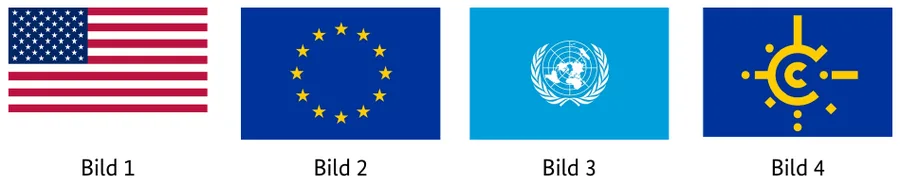
The correct answer is picture 2: the blue flag with a circle of twelve gold stars. The number twelve stands for perfection and unity, not for the number of member states.
The DDR's accession on 3 October 1990 is called "Deutsche Wiedervereinigung" (German reunification) because East and West became one state again after more than 40 years of division. The EU and NATO eastern enlargements came later and concerned other countries.
A Damit sind amerikanische Einwanderinnen und Einwanderer in Europa gemeint.
B Der Begriff meint den Einwanderungsstopp nach Europa.
C Damit sind europäische Auswanderinnen und Auswanderer in den USA gemeint.
D Der Begriff meint den Zusammenschluss europäischer Staaten zur EU.✓ correct
Explication (EUpassway, non officielle)
"European integration" means that European states work together ever more closely, from the EEC in 1957 to today's EU. The term has nothing to do with immigration or emigration.
C die Abgeordneten des Europäischen Parlaments✓ correct
D die europäische Verfassung
Explication (EUpassway, non officielle)
In the European election citizens elect the members of the European Parliament; Germany has 96 of them. The European Commission is not directly elected by the people.
The official seat of the European Parliament is Strasbourg (Straßburg) in France, where most plenary sessions take place. Other working places are Brussels and Luxembourg, but not London, Paris or Berlin.
Le catalogue original montre ici une photo de presse ; elle n’est pas reproduite. Le texte suffit pour répondre.
A Freundschaft zwischen England und Deutschland
B Reisefreiheit in alle Länder der EU
C Frieden und Sicherheit in den Ländern der EU✓ correct
D einheitliche Feiertage in den Ländern der EU
Explication (EUpassway, non officielle)
In 1984 Mitterrand and Kohl held hands in Verdun, the site of a bloody battle in the First World War. This shows the main goal of European unification: peace and reconciliation between former enemies.
B Gründung der Europäischen Wirtschaftsgemeinschaft (EWG)✓ correct
C Verpflichtung Deutschlands zu Reparationsleistungen
D Festlegung der Oder-Neiße-Linie als Ostgrenze
Explication (EUpassway, non officielle)
With the Treaties of Rome in 1957, Germany, France, Italy and the Benelux countries founded the European Economic Community (EWG/EEC) and Euratom. The EEC is a forerunner of today's EU.
The European Parliament works in three places: plenary sessions in Strasbourg, committees and additional sessions in Brussels, and the General Secretariat (administration) in Luxembourg.
In 1957 West Germany signed the "Treaties of Rome" (Römische Verträge) and thereby founded the EEC with five other states. The "Paris Treaties" (1951/1954) dealt with other matters, e.g. the Coal and Steel Community and sovereignty.
The euro was first introduced in 1999 as non-cash money. Coins and notes have existed since 1 January 2002; since then people in Germany pay in cash with euros instead of the Deutsche Mark.
B Sie muss einen Antrag bei der Elterngeldstelle stellen.✓ correct
C Sie muss nichts tun, denn sie bekommt automatisch Elterngeld.
D Sie muss das Arbeitsamt um Erlaubnis bitten.
Explication (EUpassway, non officielle)
Elterngeld (parental allowance) is not paid automatically: you must submit a written application to the Elterngeldstelle (parental allowance office), ideally soon after the birth. It is paid retroactively for at most three months.
B Sie müssen nichts tun. Man darf in Deutschland jederzeit überall demonstrieren.
C Sie können gar nichts tun, denn Demonstrationen sind in Deutschland grundsätzlich verboten.
D Maik und Sybille müssen einen neuen Verein gründen, weil nur Vereine demonstrieren dürfen.
Explication (EUpassway, non officielle)
Freedom of assembly is guaranteed (Article 8 of the Grundgesetz, Basic Law), but an outdoor demonstration must be registered with the responsible authority in advance, normally 48 hours before. No permit or association is needed.
To study at a university you normally need the Abitur (general higher education entrance qualification). A Diplom is a university degree, and the Gesellenprüfung is the final exam of a vocational apprenticeship.
Anne is 13 and therefore still a child; criminal law gives children under 14 special protection, so a relationship with an adult is forbidden. Adults, on the other hand, may live together freely, including same-sex couples or with a large age gap.
In Germany you come of age at 18 (since 1975). From then on you may, for example, sign contracts on your own and vote in the Bundestag (federal parliament) election.
Mutterschutz (maternity protection) protects pregnant women and mothers: as a rule they may not work 6 weeks before and 8 weeks after the birth and are protected from dismissal. Elternzeit (parental leave) is different; both mother and father can take it afterwards.
According to Article 6(2) of the Grundgesetz (Basic Law), caring for and raising children is the natural right and duty of the parents. The state only watches that children are doing well.
Parents are mainly responsible for raising children (Article 6 of the Grundgesetz, Basic Law). Schools and the state only support them; the state steps in when a child's welfare is at risk.
On the job market, training and qualifications count most. Religion, gender or party membership must not play a role in hiring (General Equal Treatment Act).
Children have a right to a non-violent upbringing (Section 1631 of the Civil Code, since 2000). Anyone who hits a child can be punished, e.g. for bodily harm; it is not just a family matter.
A darf man zur gleichen Zeit nur mit einer Partnerin/einem Partner verheiratet sein.✓ correct
B kann man mehrere Ehepartnerinnen/Ehepartner gleichzeitig haben.
C darf man nicht wieder heiraten, wenn man einmal verheiratet war.
D darf eine Frau nicht wieder heiraten, wenn ihr Mann gestorben ist.
Explication (EUpassway, non officielle)
In Germany you may be married to only one person at a time; bigamy is forbidden and a criminal offence. After a divorce or the partner's death you may marry again.
After moving you must register within two weeks at the Einwohnermeldeamt (residents' registration office, often called Bürgeramt). The Standesamt (registry office) handles marriages and births, the Gewerbeamt handles businesses.
B Die Ehegatten sind ein Jahr verheiratet, dann ist die Scheidung möglich.
C Das Besuchsrecht für die Kinder gilt ein Jahr.
D Die Ehegatten führen mindestens ein Jahr getrennt ihr eigenes Leben. Danach ist die Scheidung möglich.✓ correct
Explication (EUpassway, non officielle)
Before a divorce the spouses usually have to live separately for at least one year. This shows the family court that the marriage has really broken down; you can even separate within the same flat.
The Jugendamt (youth welfare office) advises and supports parents with parenting questions and family problems, e.g. through parenting counselling. The Ordnungsamt (public order office) and the Gesundheitsamt (health office) have other tasks.
D eine Gaststättenerlaubnis von der zuständigen Behörde✓ correct
Explication (EUpassway, non officielle)
Anyone wanting to open a restaurant that serves alcohol needs a licence under restaurant law (Gaststättenrecht) or must register the business with the responsible authority (usually the trade or public order office). The police, a party or the residents' registration office are not responsible.
The Abendgymnasium (evening grammar school) is a school for adults who want to obtain the Abitur alongside their job. You can only study at a university after the Abitur; the Hauptschule does not lead to the Abitur.
B Es kann ein Kind, das geschlagen wird oder hungern muss, aus der Familie nehmen.✓ correct
C Es bezahlt das Kindergeld an die Eltern.
D Es kontrolliert, ob das Kind einen Kindergarten besucht.
Explication (EUpassway, non officielle)
If a child is in danger, e.g. because it is beaten or has to go hungry, the Jugendamt (youth welfare office) may temporarily take it out of the family (Inobhutnahme, protective custody). Kindergeld (child benefit), however, is paid by the Familienkasse, and parents choose the school.
At the Berufsinformationszentrum (BIZ, career information centre) of the Federal Employment Agency you can learn about jobs and training and get help finding an apprenticeship (Lehrstelle). Other bodies are responsible for pensions, taxes and health insurance.
Germany has compulsory schooling (Schulpflicht): children must attend lessons regularly, which means compulsory attendance. If a child is absent without reason, the parents can be fined.
Adults can obtain the Abitur at an Abendgymnasium (evening grammar school) or a Kolleg, often alongside work. Universities and private universities already require the Abitur.
A Niemand darf z.B. wegen einer Behinderung benachteiligt werden.✓ correct
B Man darf andere Personen benachteiligen, wenn ausreichende persönliche Gründe hierfür vorliegen.
C Niemand darf gegen Personen klagen, wenn sie benachteiligt wurden.
D Es ist für alle Gesetz, benachteiligten Gruppen jährlich Geld zu spenden.
Explication (EUpassway, non officielle)
Equal treatment means that no one may be disadvantaged because of, for example, disability, gender, origin or religion (Article 3 of the Grundgesetz, Basic Law, and the General Equal Treatment Act). Anyone who is disadvantaged can defend themselves and also go to court.
From age 14 you can be punished for crimes. However, young people go before a juvenile court and are dealt with under juvenile criminal law, so not like adults.
Rosenmontag (Rose Monday) is the high point of Karneval or Fasching (carnival), especially in the Rhineland, with parades of colourful costumes and masks. The Oktoberfest is a folk festival in Munich without costumes.
Anyone who wants to marry must first register the marriage at the Standesamt (registry office). Only the civil ceremony is legally valid; a church wedding can be held in addition.
Night-time quiet (Nachtruhe) usually starts at 10 pm and lasts until 6 am. During this time you should not make noise that disturbs the neighbours, e.g. loud music.
A Sie müssen die Entscheidung der volljährigen Tochter respektieren.✓ correct
B Sie haben das Recht, die Tochter in die elterliche Wohnung zurückzuholen.
C Sie können zur Polizei gehen und die Tochter anzeigen.
D Sie suchen einen anderen Mann für die Tochter.
Explication (EUpassway, non officielle)
At 22 the daughter is an adult and may decide for herself whom she lives with. The parents must respect this; they may not bring her back home or choose a husband for her.
A Sie muss mindestens zehn Jahre in Deutschland leben, bevor sie den Führerschein machen kann.
B Wenn sie kein Deutsch kann, darf sie keinen Führerschein haben.
C Sie muss den Führerschein in dem Land machen, in dem man ihre Sprache spricht.
D Sie kann die Theorie-Prüfung vielleicht in ihrer Muttersprache machen. Es gibt mehr als zehn Sprachen zur Auswahl.✓ correct
Explication (EUpassway, non officielle)
The theory driving test can be taken not only in German but also in twelve foreign languages, e.g. English, Turkish or Arabic. There is no minimum residence period of ten years.
Since 1996 children from age three until they start school have a legal right to a kindergarten place; since 2013 there is a right to childcare from their first birthday. There is, however, no obligation to attend.
The Volkshochschule (VHS, adult education centre) is a public institution for further education for all adults, e.g. language, integration and computer courses. It is not only for young people or pensioners.
At Christmas many families put up a fir tree and decorate it with candles, baubles and stars. Hiding eggs belongs to Easter, costumes to carnival and pumpkins to Halloween.
A Mann und Frau sind geschieden und leben mit neuen Partnern zusammen.
B Zwei Frauen leben zusammen.
C Ein alleinerziehender Vater lebt mit seinen zwei Kindern zusammen.
D Ein Mann ist mit zwei Frauen zur selben Zeit verheiratet.✓ correct
Explication (EUpassway, non officielle)
In Germany a man may not be married to two women at the same time; bigamy is forbidden and a criminal offence. Same-sex couples, blended families and single parents, on the other hand, are allowed.
For parenting problems the Jugendamt (youth welfare office) is the right place; it offers counselling and parenting support. The health office and the residents' registration office are not responsible for this.
The Briefgeheimnis (secrecy of correspondence, Article 10 of the Grundgesetz, Basic Law) protects private mail. Anyone who deliberately opens someone else's letter violates it and can even commit a criminal offence.
D die Unterstützung einer Anwältin/eines Anwalts✓ correct
Explication (EUpassway, non officielle)
A divorce is decided by the family court, and the person who files for divorce must be represented by a lawyer. The consent of parents or children is not required.
D Ich kann mich bei der Behördenleiterin/beim Behördenleiter beschweren.✓ correct
Explication (EUpassway, non officielle)
If you are treated badly at a public authority, you can complain to the head of the authority, e.g. with a formal complaint (Dienstaufsichtsbeschwerde). Authorities must treat everyone correctly and respectfully; threats are not a solution.
An applicant must not be rejected only because she is a mother. This is forbidden by the Allgemeines Gleichbehandlungsgesetz (AGG, General Equal Treatment Act); missing language skills, lack of experience or high salary demands, by contrast, are objective job-related reasons.
No one may be disadvantaged because of a disability (Article 3(3) of the Grundgesetz, Germany's Basic Law/constitution). Using a wheelchair does not stop anyone from working as an accountant, so rejecting him for that reason is discrimination.
A Regeln für die Benutzung öffentlicher Verkehrsmittel.
B alle Mieterinnen und Mieter im Haus.
C Regeln, an die sich alle Bewohnerinnen und Bewohner halten müssen.✓ correct
D die Adresse des nächsten Ordnungsamtes.
Explication (EUpassway, non officielle)
The Hausordnung (house rules) contains rules for living together in the building, for example quiet hours, waste separation or cleaning the stairwell. All residents must follow them.
To challenge a tax assessment (Steuerbescheid), you file an Einspruch (formal objection) with the Finanzamt (tax office), normally within one month. If you do nothing, the assessment becomes final as it is.
According to Article 3 of the Grundgesetz (Basic Law), all people are equal before the law and no one may be disadvantaged because of origin or skin colour. Turning people away because of their skin colour violates the right to equal treatment (Gleichbehandlung).
Anyone appointed as a Wahlhelfer (election volunteer) must take on this honorary role under electoral law and may refuse only for important reasons. Election volunteers run polling stations and count the votes; the other activities are voluntary.
B Ich lege Widerspruch bei der Behörde ein.✓ correct
C Ich schicke die Rechnung an die Behörde zurück.
D Ich gehe mit der Rechnung zum Finanzamt.
Explication (EUpassway, non officielle)
Against a wrong decision or bill from an authority, you lodge a written Widerspruch (objection) with that same authority, usually within one month. Simply ignoring the bill or sending it back is not enough.
B Erwachsene müssen auch nach der Ausbildung immer weiter lernen.✓ correct
C Kinder lernen in der Schule alles, was im Beruf wichtig ist. Nach der Schule muss man nicht weiter lernen.
D Alle müssen früher aufhören zu arbeiten, weil sich alles ändert.
Explication (EUpassway, non officielle)
Because technology and jobs change quickly, people have to keep learning after school and vocational training (lifelong learning). Germany offers many options for this, for example at the Volkshochschule (adult education centre).
Wage tax (Lohnsteuer) and social insurance contributions (pension, health and unemployment insurance) are deducted directly from the salary. Umsatzsteuer (VAT), by contrast, is paid as part of the price when buying goods and services.
The Betriebsrat (works council) is elected by the employees (possible from 5 employees) and represents their interests towards the employer, for example on dismissals or working hours. A Betriebsprüfer, by contrast, is a tax auditor who checks the company for the tax office.
If you want to quit, you must observe the Kündigungsfrist (notice period) set in your employment contract or by law. By law, for employees this is at least four weeks to the 15th or the end of a month, and the notice must be given in writing.
A aus der Mitgliedschaft in der Europäischen Union (EU)
B aus den nationalsozialistischen Verbrechen gegen Juden✓ correct
C aus dem Grundgesetz der Bundesrepublik Deutschland
D aus der christlichen Tradition
Explication (EUpassway, non officielle)
Under National Socialism, about six million Jews were murdered (the Holocaust/Shoah). Germany's special responsibility for Israel and for protecting Jewish life comes from these crimes.
No one may be disadvantaged because of skin colour or origin (Article 3 of the Grundgesetz and the AGG, the General Equal Treatment Act). Weak German skills or lack of work experience, by contrast, can be objective reasons for a rejection.
If a newly bought item is broken, you can make a complaint (reklamieren) to the seller. Under the statutory warranty (Gewährleistung, 2 years), the seller must then repair it or supply a new device.
A es eine Kirchensteuer gibt, die an die Einkommen- und Lohnsteuer geknüpft ist.✓ correct
B das für die Statistik in Deutschland wichtig ist.
C man mehr Steuern zahlen muss, wenn man nicht zu einer Kirche gehört.
D die Kirche für die Steuererklärung verantwortlich ist.
Explication (EUpassway, non officielle)
Members of the major churches pay church tax (Kirchensteuer); it amounts to 8 or 9 percent of the income or wage tax and is collected by the tax office. Anyone who does not belong to a tax-collecting church does not pay it.
D Der Staat entscheidet, an welchen Gott die Menschen glauben.
Explication (EUpassway, non officielle)
Religious tolerance means everyone may freely choose which religion to believe in, or not to believe at all (Article 4 of the Grundgesetz, Basic Law). The state does not prescribe any faith and protects all religions.
At Easter (Ostern), people paint eggs and hide them, often for children. A fir tree is decorated at Christmas, and fireworks are set off on New Year's Eve (Silvester).
Pfingsten (Pentecost) is a Christian holiday 50 days after Easter. Christians celebrate the coming of the Holy Spirit to Jesus' disciples; Whit Monday is a public holiday throughout Germany.
Christianity shaped Europe and Germany over many centuries, for example through holidays such as Christmas and Easter, churches and values. Other religions are also present in Germany today but did not shape its culture for so long.
Advent (Adventszeit) covers the four Sundays before Christmas; many people light one more candle on the Advent wreath each Sunday. Buß- und Bettag, Erntedankfest (harvest festival) and Allerheiligen (All Saints' Day) are single holidays in autumn.
The largest group of people with a migration background in Germany has Turkish roots. Many came as guest workers (Gastarbeiter) from 1961 onwards, and their families followed later.
The GDR (DDR, former East Germany) mainly brought so-called contract workers (Vertragsarbeiter) from socialist partner countries, especially Vietnam, Mozambique and Poland. They were usually allowed to stay only for a limited time.
In the 1950s and 1960s, West Germany recruited workers from abroad and called them Gastarbeiter (guest workers), because people assumed they would only stay for a short time. Many, however, stayed in Germany permanently.
West Germany signed its first recruitment agreement in 1955 with Italy. Later came, among others, Spain and Greece (1960), Turkey (1961) and Portugal (1964).
Quelle: BAMF, Gesamtfragenkatalog, Stand 07.05.2025
Cookies sur EUpassway
Les cookies nécessaires vous gardent connecté. Avec votre accord, nous retenons aussi votre examen et comptons les visites de façon anonyme. Détails
Nous utilisons des cookies nécessaires pour vous garder connecté et enregistrer vos essais. Avec votre accord, nous retenons aussi l'examen choisi et mesurons les visites avec Google Analytics (statistiques anonymisées, pas de publicité). Vous pouvez modifier ce choix à tout moment. Détails des cookies